
Preview build: this site is not launched yet. The inquiry form is not connected and messages sent from it will not be delivered. The form and the email address go live when this site launches.
Browse by family
Rubber Boots
Wet ground, mud and puddles.
Neoprene Boots
Long work in or beside water.
Rain Boots
Rainy days and wet paths.
Waders
Standing in water itself.
Hunting Boots
Woodland, fields and wet edges.
Safety Boots
Work use, protection to confirm.
Snow Boots
Snow, frozen ground and cold.
Hiking Boots
Trails, distance and load.
Camping Tents
The camp, the group and the season.
Camping Accessories
The jobs that serve the camp.
Fishing Gear
The water and the fishing pattern.
Hunting Gear
The ground and the hunting day.
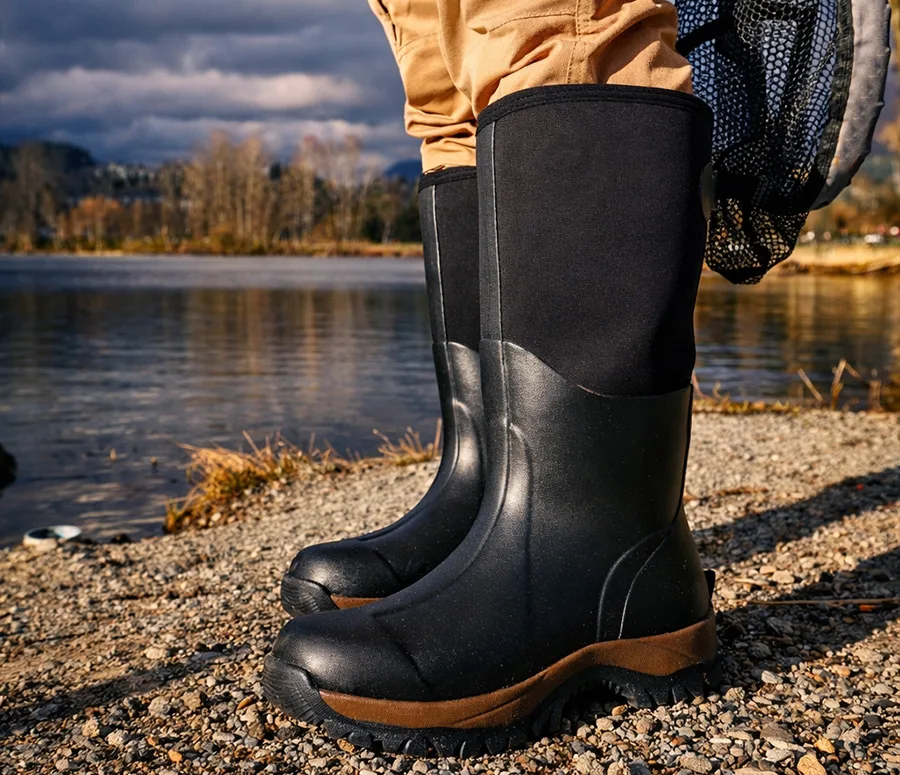
Boot families
The boot families on this site are rubber boots, neoprene boots, rain boots, waders, hunting boots, safety boots, snow boots and hiking boots. Each family page stays at family level: it describes where the family is used, what a buyer usually sorts out before ordering, and what to put in an inquiry. No family page lists a named model, and no page publishes a size, a weight, a colour range or a price. That restraint is deliberate. A buyer who writes down the use first, and the exact items second, writes a clearer inquiry than a buyer who starts from a catalogue code they have not checked.
Rubber boots and rain boots cover wet ground and wet days. Neoprene boots cover work that stays in or beside water. Waders cover standing in water itself, with separate guidance pages for chest waders, fishing waders, hip waders and neoprene waders, because the depth of the water and the way the wearer moves through it change the choice. Hunting boots and hunting gear are kept apart from fishing gear, so the two uses are never mixed in one inquiry. Safety boots and the safety boots guide deal with work use, where the protection type must be confirmed before ordering. Snow boots and the winter boots guide deal with cold and snow, where the buyer should describe the cold the boots will face rather than assume a rating.
Camping tents, accessories and fishing gear
Camping tents and accessories and fishing/hunting gear are presented at family level only, secondary to the boot families. There is one page for camping tents, one for camping accessories, one for fishing gear and one for hunting gear, plus guidance pages that help buyers ask about tent stakes, camping sleeping mats, camping lights, fly fishing gear and ice fishing gear. None of those pages lists a tent size, an item specification or a named product. The guidance on each page is about how to describe what is needed: the setting, the number of people or the size of the group being served, the season, and the items that must travel together. A bulk buyer who describes the trip or the camp first puts the right family in the inquiry, rather than a guess about a single item.
The same rule applies to the comparison and guide pages. The comparison of rubber boots and neoprene boots explains the questions that separate the two families without publishing a material specification. The comparison of waders and rain boots explains when standing in water calls for waders and when wet ground calls for boots. The comparison of hiking boots and hiking shoes is a guide only: it compares the two kinds of footwear so a buyer can describe the ground and the load, and it does not present shoes as a supplied product. The work boots guide, the winter boots guide and the safety boots guide all end in the same place: a short list of things to confirm before ordering.
How to buy from this site
Every page on this site ends with the same practical step. Send your item list and quantities for a quote, and include the destination market in your message. An item list works best when it names the family, the use, and anything the wearer or the user must be able to do while wearing or using it. Quantities should be stated plainly, with any split by group or by size range the buyer already knows, and with anything still undecided marked as undecided rather than guessed. The destination market matters because it shapes the questions that follow, including which documents to ask for.
Certificates are available upon request. Ask for the documents that apply to your market when you send the inquiry, and name the market in the same message as the documents requested. Do not assume a document from a listing title. The inquiry form on the contact page and the email address in the footer will be the two ways to reach the company when this site launches. This is a preview build: the form is not connected yet and messages sent from it will not be delivered. No phone number or named contact is listed on this site. Include your item list, quantities and destination market in your message, and state clearly anything that must be confirmed before ordering.
Guides, comparisons and wholesale pages
The guide pages exist for buyers whose choice is still open. The comparison of rubber boots and neoprene boots settles wet ground against long water work. The comparison of waders and rain boots settles standing in water against walking through a wet day. The comparison of hiking boots and hiking shoes is a guide only, and it settles the trail question without presenting shoes as a supplied product. The step-by-step guides cover how to choose waders, how to choose boots for work, how to choose boots for winter, and how to confirm toe protection for safety boots. Each guide ends with the same discipline: describe the use, confirm what applies, and then write the inquiry. A buyer who works through the guide that matches the open question will write an inquiry that describes the use completely, with no open question about the use itself left undescribed.
The wholesale pages cover bulk inquiries. The wholesale boots page sets out how to structure an item list sorted by family and use, with quantities stated plainly and the destination market named in the same message. The wholesale rubber boots page applies the same structure to rubber boots alone, sorted by ground group. The boots supplier page gathers the whole listing in one place for buyers who start from the company rather than from a family. All three pages carry the same rule: no quantity threshold and no price is published, timing questions are asked directly in the inquiry, and anything to confirm before ordering is stated in the same message as the item list.
How evidence is worded on this site
Evidence on this site is worded narrowly on purpose. The founding year appears only with its attribution: Hangzhou Fujie Outdoor Products Inc. states on its company profile that it was founded in 2007. The boot lines in the evidence strip are described as listed on the company website. The location is given at city level only, in the same form on every page. Certificates are available upon request, and that sentence is the only certificate wording used anywhere on the site. No rating, badge or standard designation appears on any page, and no document number is published. No page publishes a size, a weight, a colour range, a price, a quantity threshold or a timing figure. A buyer who needs any of those things should ask for it in the inquiry, and should keep any answer received with the quote.
The same narrow wording applies to the families. Shop-anchored families — camping tents, camping accessories, fishing gear and hunting gear — are presented at family level only, with guidance on describing the camp, the water or the day, and with no item specification. Protection words appear only with confirmation framing, and only on the guide pages that deal with work and safety. Hiking shoes appear only as comparison context. These limits are not missing content waiting to be filled. They are the boundary between what the company listing evidences and what only an inquiry can confirm, and this site stays inside that boundary on every page.
Images on this site follow the same rule. The company-site images are used only as category illustrations, with captions that describe what the picture shows and nothing more. The other content images are generic illustrations of outdoor scenes — a riverbank, a marsh, a snowy trail, a warehouse aisle — and their captions say so. No content image on this site is presented as a named product, a workplace, a team, or a document, and the generic illustrations carry no logo, legible text or mark that would suggest otherwise. The company logo appears only in the header and footer, as a logo. A buyer who reads a caption should be able to trust exactly what it says, and nothing beyond it.
Planning a first inquiry
A first inquiry should be planned in three passes. First, read the family page that matches the ground, the water or the job, and the guide page that matches any open choice. Second, write the description: the ground or water, the season and hours, the wearer groups, and the pattern of use, each in plain words. Third, write the list: the families and uses, the quantities with estimates marked as estimates, the destination market, and the confirmation questions, all in one message. The contact page carries the form and the email address, and both routes will take the same message when the site launches. A buyer who plans the inquiry in three passes sends the description, the list and the questions together, in a single message.
If the order serves more than one use, plan it as more than one list. Boots, tents, accessories and gear each get their own list, sorted by their own use, and the lists travel together in one message with the destination market stated once. If a use is still undecided, say so in the inquiry and state what would decide it, rather than guessing a family or an item to fill the gap. The guides on this site exist to turn undecided uses into stated questions, and a stated question can be put as a confirmation question in the inquiry. The blog guides at the foot of this page work through the same planning at greater length for buyers who want to read further before writing.
Keep any written confirmation received with the inquiry. When a written confirmation is received, check it against the description that was sent: the ground or water, the season and hours, the wearer groups, and the quantities, each as they were stated. If a confirmation differs from the description, raise it before the order is placed, in the same thread, so the record stays whole. If a confirmation answers a question that was marked undecided, file it with the answer that decided it. An order placed on confirmations that match the description is an order the buyer can stand behind, and a description kept with its confirmations is the simplest filing system a buying team can run.
Guides from the blog
- Rubber Boots Care — Cleaning, drying and storage after wet days.
- Neoprene Boots for Wet Work — The water, the hours and the ground to confirm.
- Fishing or Hunting Waders — Two waters, two days, one honest split.
- Camping Tent Checklist — Camp, group, season and accessories for bulk buyers.
- Safety Boots at Work — Protection types to confirm before ordering.
- Outdoor Trip Packing — Boots, tents and gear, sorted by the trip.
Related pages
Send an inquiry
Start with the family that matches your ground or your water, then send your item list and quantities for a quote.