
Rubber Boots
Rubber boots are the wet-ground family in the Hangzhou Fujie Outdoor Products Inc. listing: boots for ground that stays wet, for mud after rain, and for work that moves between dry ground and standing water in the course of a day. This page stays at family level and helps a buyer sort an order by use before writing an item list.
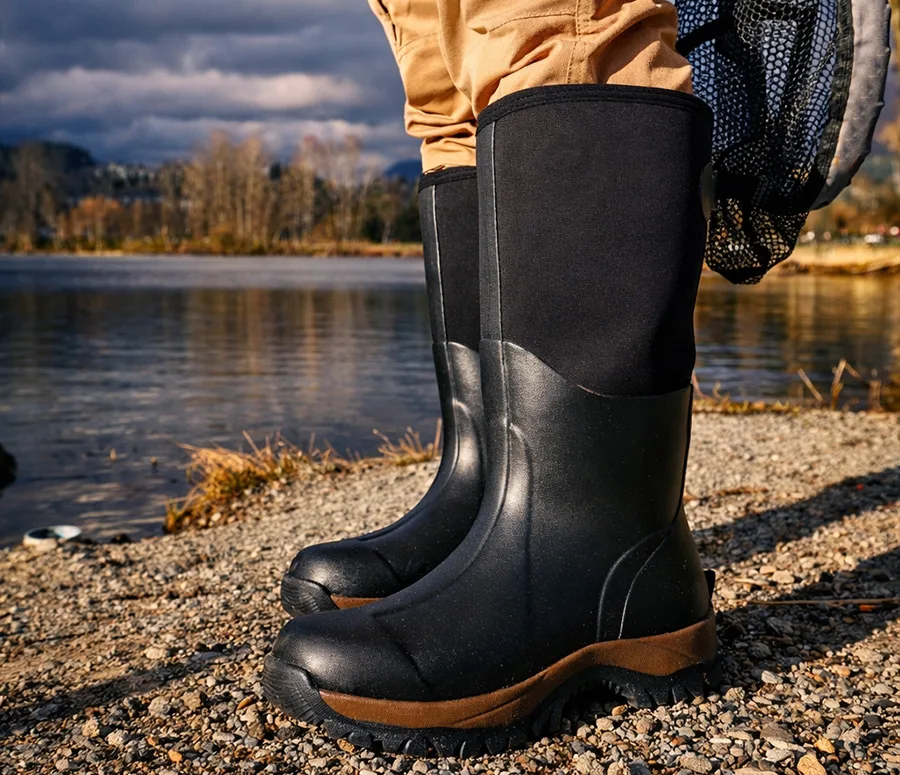
Where rubber boots are used
Buyers reach for rubber boots when the ground itself is the problem. Farm tracks after rain, yards that hold puddles, paths through wet grass, and work areas where water is hosed or splashed across the ground all call for a boot that can stand in wet conditions and be cleaned afterwards. The question to settle first is not a product detail but a description of the ground: how wet it stays, how deep the water gets, how far the wearer walks, and whether the ground is soil, gravel, stone or a hard yard surface. A buyer who can describe the ground in those plain terms has already done most of the sorting, because the same family serves very different days depending on whether the water is a thin film or a pool the wearer must step through.
The same description helps separate rubber boots from the neighbouring families. If the wearer will stand in water rather than walk through it, the waders pages are the right place to start, and the comparison of waders and rain boots sets out the dividing line. If the water work is continuous and the wearer stays in or beside moving water, the neoprene boots page and the waders pages should be read alongside this one. If the use is hunting, the hunting boots page covers that ground. Rubber boots sit in the middle of that map: the family for wet ground that is walked on, worked on and crossed, rather than water that is stood in.
Sorting an order by use
Sort the order by the days the boots must serve, not by a catalogue order. List each use separately: the farm track in the morning, the yard at midday, the wet path between them. For each use, note the ground, the depth of water, the distance walked and the hours worn. Then note who wears the boots in each use, in plain group terms the buyer already knows, such as the people working a site or the people walking a route. A list sorted this way makes it clear whether one family covers every use or whether two families are needed, and it keeps the inquiry honest about anything still undecided, because an undecided use can be marked as undecided instead of being forced into a family it does not fit.
Quantities follow the same sorting. State how many wearers each use involves and how the total splits across the uses, and say which splits are firm and which are still estimates. If the order serves more than one site or more than one group, say so in the inquiry, and keep the groups separate in the item list rather than merging them into a single total. The destination market belongs in the same message. A clear list of uses, wearer groups and quantities puts each use, wearer group and quantity in the message, and it avoids the common mistake of ordering a single total for several different days.
What to confirm before ordering
Before ordering, confirm the questions that this page cannot answer from family level alone. Confirm how the boots handle the depth of water the wearer will actually meet, and confirm anything about the ground that affects the choice, such as sharp stone, deep mud or a hard yard surface. Confirm how the boots are to be cleaned after a wet day, and confirm what the wearer should check when the boots are first worn. Ask these questions in the inquiry, in the same message as the item list, and keep any answers received with the quote. A buyer who confirms the use first, and orders second, avoids the cost of a delivery that fits the catalogue but not the ground.
Related pages
Send an inquiry
Describe the ground and the uses, then send your item list and quantities for a quote.